
By: Mark McCrindle
As we look to the future of marketing and the future consumer, the task is to adapt the tools, not truths. By elevating timeless human needs in timely ways, organisations can navigate disruption with a proactive disposition that energises others.
In the rapidly evolving consumer landscape, marketing teams are navigating an era defined not by linear growth, but by paradoxes. As we chart this new terrain, we see a world where disruptive innovation and enduring human needs collide, creating a complex roadmap for brand relevance.
In an era of rapid change, marketing leaders are navigating an era defined not by linear growth, but by paradoxes and accelerating change. As we explore this new terrain, we see a world where disruptive innovation and enduring human needs collide. Brands need to find a way to meet people where they are at amidst the volatility and complexity of this era of disruption.
To position your brand effectively, organisations must become both agile and anchored, embracing the shifts of the future while staying grounded in timeless human needs. Despite the paradoxes at play we see that while times change quickly, people remain anchored by unchanging social behaviours and human drivers.
Here is how businesses and organisations can tap into timeless human needs to build meaningful connections in a rapidly transforming world.
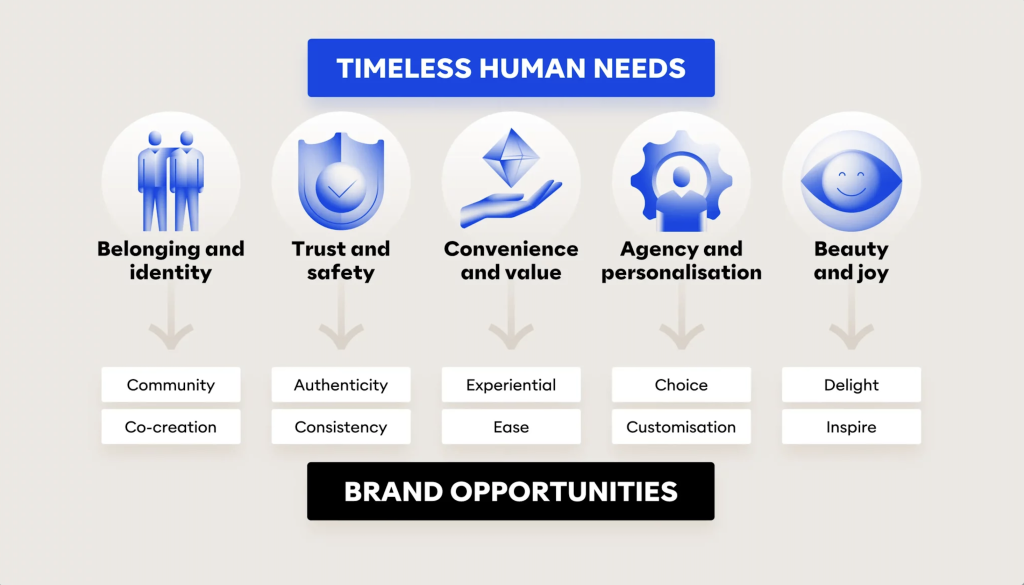
Belonging & Identity
Society is more digitally connected than ever, yet it remains socially fragmented. Our research reveals that 56% of Australians often or sometimes feel lonely. This isolation is most acute in younger generations, reaching 71% for Gen Z and 69% for Generation Y, aka The Millennials.
People ultimately crave connection to communities and causes that reflect who they are. The opportunity is to move beyond selling a product and focus on creating a community around a shared identity. Do this by inviting your customers to co-create impact. Brand experiences that facilitate belonging can act as a powerful antidote to the isolation many consumers feel.
Trust & Safety
We are witnessing a significant shift from tech optimism to tech scepticism. Today, 78% of consumers are concerned about how their personal data will be used in AI-driven shopping experiences.
In this environment, ethical creation and transparency are no longer premium differentiators—they have become “hygiene factors”. The opportunity is to build trust through integrity and consistent brand values but also prioritise authenticity and truth over perfection. In an age of curated realities, consumers are far more likely to reward brands that offer radical transparency in their supply chains and data practices.
Convenience & Value
While consumers are increasingly values-driven, they face real-world constraints of time, money, and convenience. This “consumer pragmatism” means that 74% of people will still buy an additional item just to unlock free shipping, and 56% would purchase a cheaper product even if they know it is bad for the environment. The opportunity is to use technology to provide “intelligent convenience”, predicting needs before they arise but to focus on the AI strategy as much as the human emotion. For the 67% of Gen Y excited about the time savings from AI, the goal is to make the purchasing journey experiential, affordable, and frictionless.
Agency & Personalisation
The rise of the subscription economy has brought both convenience and complexity. While 89% of Australians agree subscriptions allow them to always have something new, 57% feel overwhelmed trying to keep track of them. The opportunity is that consumers want the agency to shape their own lives and express their unique identities. The strategy is to empower your audience with choice. Offer a mix of ownership and access models to suit different generational needs, ensuring you are reducing their mental load rather than adding to it.
Beauty & Joy
We are moving into a “post-material” world where wealth is increasing, but satisfaction is often decreasing. 77% of consumers are now more interested in experiences and meaning than accumulating material possessions.
Remarkably, even under economic strain, 69% of Australians choose to splurge on small luxuries that provide emotional comfort. The opportunity here is that throughout history, people have been inspired by beauty. The response for marketing teams is to invest in creating meaningful, beautiful experiences that bring joy. In an AI-driven world, elevating these human-centric moments will be the key to brand longevity.
Want to understand not just the timeless human needs, but the ways the different generations engage with brands? Download McCrindle’s Generational Consumer Profiles Infographic to discover the specific drivers and values shaping every generation of the modern consumer.
Article supplied with thanks to McCrindle.
About the Author: McCrindle are a team of researchers and communications specialists who discover insights, and tell the story of Australians – what we do, and who we are.
Feature image: Canva